Pages

Showing posts with label SM. Show all posts

Thursday, June 8, 2023

Zulu

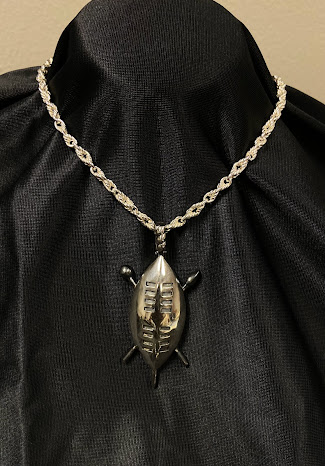
This is Incweba made this a buck's horn.

There are several traditional Zulu beliefs and rituals related to spiritual protection and direction. Use of items or symbols said to have special powers or meaning is part of several of these rituals. For protection, some animal hides, horns or bones may be worn or carried, and Incweba is one of those amulet that are believed to have protection spiritual powers.

It's possible that certain talismans or symbols have special significance in Zulu culture, but it's crucial to do your research on them and treat them with consideration for the traditions and beliefs of the Zulu people.

Islamic

This is a metal Taweez locket with Quran verses.


A locket known as a taweez is typically associated with Islam, though one can also find ones connected to Hinduism. On the metal part of the Taweez, verses from the Quran or other prayers and Islamic symbols are typically etched. Typically, a strong black string is used to hang this necklace made of metal or black fabric. While some also wear it around the arm, most do so around the neck.

It is typically worn by the majority of Sufis and a small percentage of Muslims, and its wearer is believed to be protected from any evil or affliction that may be brought on by black magic.  

Wednesday, June 7, 2023

Shembe

This is a Ifodo amulet which is a necklace with a picture of Shembe.


A religious object connected to the Nazareth Baptist Church, commonly known as the Shembe Church, in South Africa is referred to as a Shembe amulet. The Shembe Church is a Christian sect that combines aspects of Zulu spirituality and culture into its doctrine.

The "Ifodo" amulet is a distinguishing item worn by adherents of the Shembe Church. Usually, it is a plastic pendant with a picture of Shembe. Frequently, the amulet is hung on a necklace.

The amulet has religious and symbolic importance for Shembe Church members. It is thought to possess spiritual strength and act as a conduit to the divine. The amulet is revered as a source of blessing, protection, and spirtual direction.

Indian(Hindu)


This a Hindu Pilgrim’s Silver Ganesh Amulet Pendant

A silver pendant with an image or portrayal of Lord Ganesha, one of Hinduism's most respected deities, is known as a Hindu Pilgrim's Silver Ganesh Amulet Pendant. Ganesha is generally revered as the destroyer of impediments, the benefactor of knowledge, intellect, and fresh starts.

Hindu pilgrims and devotees are fond of silver amulets and pendants with images of Lord Ganesha. They are frequently carried or worn as a representation of supernatural protection, blessings, and direction. The pendant acts as a constant reminder of Ganesha's presence and the virtues he stands for, like intelligence, knowledge, and conquering obstacles.


Asian (Nepal)

This is an Amulet case with Vishnu Riding Garuda

In Hinduism, a Vishnu Riding Garuda amulet is a sacred object that people frequently wear or carry as a sign of blessing and protection. It frequently includes a picture or representation of Lord Vishnu perched on the back of the heavenly bird, Garuda.

The amulet is seen as a sort of divine defense against obstructive forces, evil spirits, and negative energies since it is said to have spiritual power. Additionally, it is connected to requesting Lord Vishnu's blessings and grace, who is regarded as the universe's sustainer and defender.

Egyptian

this is an Egyptian SA amulet made with silver and electrum.

 The "Egyptian SA amulet" that you stated might be a reference to the hieroglyph "Sa" and its corresponding symbol in Egyptian culture. The hieroglyph "Sa" (also written "Saa" or "Sah") stands for security, authority, and inner fortitude.


Hieroglyphs were utilized as a form of writing in ancient Egypt and also had symbolic and magical meanings. The "Sa" hieroglyph, which is shaped like a looped or coiled string, is frequently connected to protection and is said to provide security to the carrier or wearer.

European(Roman)


This is a circular gold medallion with embossed symbols, with a pear-shaped amethyst and two pendant pearls attached. 

A scorpion, a dog, an elephant, and a bird are among the animals that make up the embossed decoration on this gold medallion, which also has a depiction of the evil eye in the center. These creatures are depicted combating the evil eye.

Such amulets were supposed to have protecting properties in Greco-Roman antiquity. Both sexes wore protective amulets in an effort to bring luck and ward off harm and disease, which were thought to be caused by demonic spirits. Amulets made of gold and silver that like the one in the JHUAM have been discovered all around the Roman Empire. These amulets occasionally have spells written on them that are comparable to those seen in papyrus records. Additionally, protective amulets can be found in burial settings, where

Thursday, May 18, 2023

Spiritual Mediation Outline


This an image of a monk doing meditation in the river.

Spiritual Mediation is an experience that takes you to the depths of who you are and jewellery has been affiliated with the spiritual and the supernatural. Things like Amulets and Talismans appear in in all cultures. 

In this report I am going to focus on some Historical Amulets and Talismans within the following cultures, European ( Greco-Roman) , Egyptian, Asian(Nepal) and Islamic. 

I will also be looking at Contemporary Amulets and Talismans within the following cultures; Zulu, Shembe and Indian(Hindu). 

Reflection

This is the IHAWU pendant  After my exhibition I had a sit down with John who is the moderator and we spoke about how he sees my work and he...