Pages

Showing posts with label Historical. Show all posts

Wednesday, August 23, 2023

Ucu

This is an image of Ucu.

Ucu is a traditional Zulu engagement ring crafted from white beads and a string. This cultural adornment holds profound significance within the context of engagement ceremonies. During this ceremonial event, a woman bestows the Ucu upon her suitor, symbolizing her acceptance of his proposal for a romantic relationship.

In instances where the woman is maintaining her virginity, a distinctive custom unfolds. She employs the assistance of fellow virgin maidens to deliver the Ucu to the man on her behalf. This practice arises from the societal norms that restrict her from directly interfacing with her prospective partner until certain conditions are met. This distinctive approach adds an extra layer of ceremonial depth to the proceedings.

The presentation of Ucu to the man conveys not only the woman's affirmation of the relationship but also augments his status within his social circle and the broader community. This revered act becomes a visible declaration that someone has chosen him, imbuing him with an elevated reputation among his peers and community members.


Isibamba

This is an image of Isibamba

Isibamba is a meticulously crafted belt, intricately composed of beads and woven grass, traditionally donned by Zulu women. This particular accessory holds significance within the context of Zulu culture, exclusively adorning the waists of married women who have also embraced the role of motherhood. 

During pregnancy, the Isibamba takes on an additional purpose, providing essential support to the expanding abdomen and the weight it carries. It's important to note that the Isibamba transcends mere ornamentation; rather, it serves as a potent symbol of marital union.

Hence, its wearing is restricted to married women, with the underlying cultural norms dictating that unmarried women are not eligible to wear this emblem of matrimony.


Isicholo

This is an image of Isicholo

The Isicholo is a unique hat crafted from grass, string, pigment, and human hair. It holds cultural significance as it was traditionally sewn onto a bride's hair, symbolizing a commitment that could not be undone until the hat naturally deteriorated and required reworking. 

This practice ensured that even in the husband's prolonged absence, the wife remained bound by her marital status, visually portraying her commitment. While the shapes and sizes of the Isicholo may vary across different clans, its unmistakable presence upon a woman's head serves as an immediate indicator of her married status.

Umqhele weNkosi

This is an image of the late Zulu king Zwelithini wearing Umqhele.

Umqhele, a C-shaped crown or headring in Zulu culture, is crafted using a string and animal skin. It's a common headpiece worn by both men and boys, but there's a distinction between versions worn by regular individuals and kings.

Regular umqhele features animal skin sewn around the structure, while the king's umqhele is adorned with leopard skin (known as ingonyama) to reflect their royal status. Additionally, the king's umqhele is embellished with feathers from the Igwalagwala bird (Turaco), symbolizing royalty. Due to the bird's association with kingship, these feathers are reserved for exclusive use by royalty.

Thursday, June 8, 2023

Islamic

This is a metal Taweez locket with Quran verses.


A locket known as a taweez is typically associated with Islam, though one can also find ones connected to Hinduism. On the metal part of the Taweez, verses from the Quran or other prayers and Islamic symbols are typically etched. Typically, a strong black string is used to hang this necklace made of metal or black fabric. While some also wear it around the arm, most do so around the neck.

It is typically worn by the majority of Sufis and a small percentage of Muslims, and its wearer is believed to be protected from any evil or affliction that may be brought on by black magic.  

Wednesday, June 7, 2023

Asian (Nepal)

This is an Amulet case with Vishnu Riding Garuda

In Hinduism, a Vishnu Riding Garuda amulet is a sacred object that people frequently wear or carry as a sign of blessing and protection. It frequently includes a picture or representation of Lord Vishnu perched on the back of the heavenly bird, Garuda.

The amulet is seen as a sort of divine defense against obstructive forces, evil spirits, and negative energies since it is said to have spiritual power. Additionally, it is connected to requesting Lord Vishnu's blessings and grace, who is regarded as the universe's sustainer and defender.

Egyptian

this is an Egyptian SA amulet made with silver and electrum.

 The "Egyptian SA amulet" that you stated might be a reference to the hieroglyph "Sa" and its corresponding symbol in Egyptian culture. The hieroglyph "Sa" (also written "Saa" or "Sah") stands for security, authority, and inner fortitude.


Hieroglyphs were utilized as a form of writing in ancient Egypt and also had symbolic and magical meanings. The "Sa" hieroglyph, which is shaped like a looped or coiled string, is frequently connected to protection and is said to provide security to the carrier or wearer.

European(Roman)


This is a circular gold medallion with embossed symbols, with a pear-shaped amethyst and two pendant pearls attached. 

A scorpion, a dog, an elephant, and a bird are among the animals that make up the embossed decoration on this gold medallion, which also has a depiction of the evil eye in the center. These creatures are depicted combating the evil eye.

Such amulets were supposed to have protecting properties in Greco-Roman antiquity. Both sexes wore protective amulets in an effort to bring luck and ward off harm and disease, which were thought to be caused by demonic spirits. Amulets made of gold and silver that like the one in the JHUAM have been discovered all around the Roman Empire. These amulets occasionally have spells written on them that are comparable to those seen in papyrus records. Additionally, protective amulets can be found in burial settings, where

Reflection

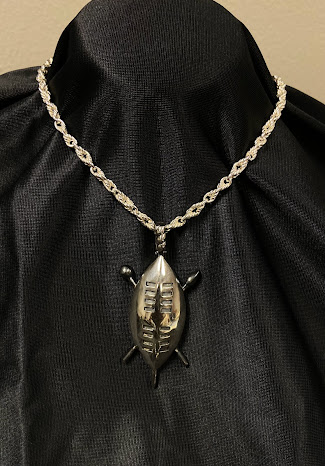
This is the IHAWU pendant  After my exhibition I had a sit down with John who is the moderator and we spoke about how he sees my work and he...